When Can You Start Feed Baby Peanut Butter
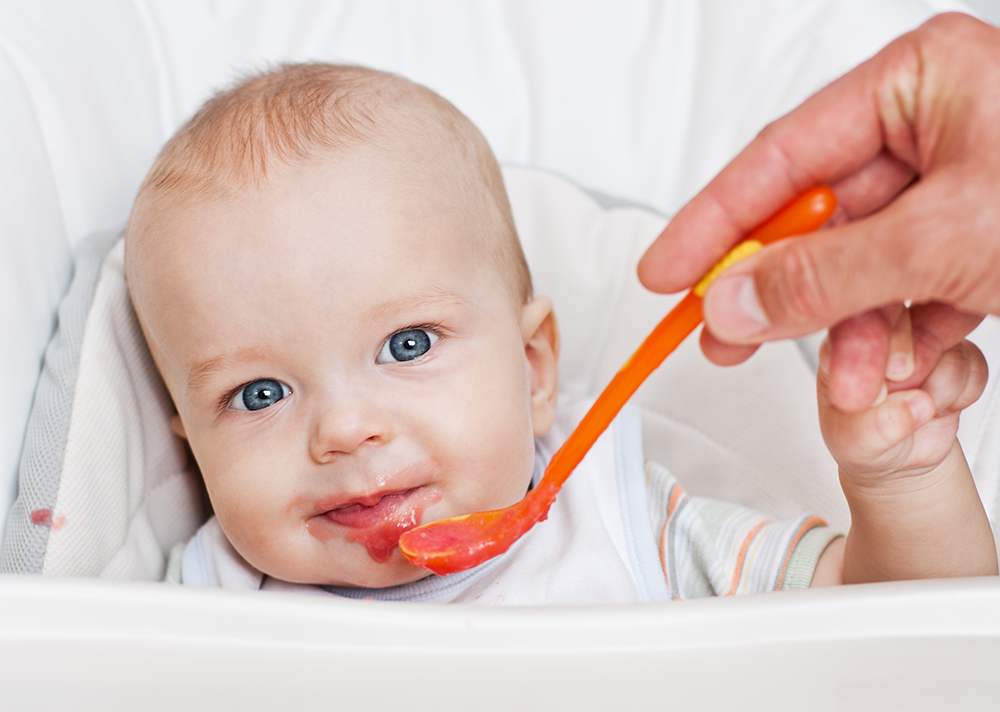
Read this in:  Čeština
  Deutsch
🖨️ Impress post
A Growing Wise Kids Column
Food is what nourishes the body and makes us healthy and potent–especially when one's weight hovers around 20 pounds! Babe nutrition is disquisitional for ensuring proper development, maximizing learning capacities and preventing disease. At no other time in life is diet so important. But which foods are best? The research clearly points in the direction of Weston A. Price Foundation principles.
Breast or Canteen
Numerous studies back up the benefits of breastfeeding. For example, breastfed babies tend to exist more robust, intelligent and free of allergies and other complaints similar intestinal difficulties.1 Other studies have shown that breastfed infants have reduced rates of respiratory illnesses and ear infections.2,3 Some researchers believe breastfed infants have greater academic potential than formula-fed infants, which is idea to be due to the fatty acid DHA establish in female parent's milk and non in most U.s.a. formulas.iv
However, other studies bear witness the reverse. In 2001, a written report found breastfed children had more asthma than canteen-fed.5 A Swedish study found that breastfed infants were just equally likely to develop babyhood ear infectionshalf dozen and babyhood cancer as formula-fed babies.vii
So, what is best for babe? It comes down to diet! Hands downward, healthy breast milk is perfectly designed for baby'south concrete and mental development, merely this is only true when mom supplies her body with the right nutrients.
The typical modern nutrition is filled with products based on carbohydrate, white flour, additives and commercial fats and oils, which do not nourish and build. The proper nutrients are necessary to create breast milk that will provide all a growing baby needs. These include skillful quality proteins from foods such equally grass-fed meats and organ meats, expert quality fats from butter, kokosnoot oil, olive oil, cod liver oil and egg yolks, equally well as complex carbohydrate-rich foods like vegetables, whole grains and legumes–think whole nutrient, natural and seasonal, with a big accent on good for you fatty.
Bottom line, in a perfect world, with perfect nutrition, every woman would breastfeed. Unfortunately, nosotros don't live in a perfect world. What almost low milk supply, an unwell mother or adoption? Luckily, information technology is possible to make a wholesome whole food baby formula. (Meet FAQs on Homemade Infant Formula.)
Later (or With) the Breast or Bottle
Ideally, breastfeeding should exist maintained for a year, with a goal of 6 months for working mothers. The kickoff year of life requires a full spectrum of nutrients, including fats, protein, cholesterol, carbohydrates, vitamins and minerals. Once chest milk is no longer the sole source of these nutrients, where should one go?
There are 3 concepts to proceed in mind. First, make your little one a "whole foods baby"! Avoid processed and refined foods as much as possible, including many brands of baby nutrient; they are commonly devoid of nutrients and accept added "undesirables." It is always best to make your ain baby food from organic, whole foods. (Y'all can freeze information technology in ane-serving sizes for later utilize.) Better-quality, additive-free, prepared brands of baby food, similar Earth's Best, do exist, but it is still improve to make your own baby nutrient to be bodacious of the quality–plus making baby nutrient puts mom on the right track for dwelling nutrient grooming for the years to come.
Second, go slowly and exist observant; every infant will have an individual response to unlike foods. Introduce new foods 1 at a fourth dimension and continue to feed that same food for at least iv days to rule out the possibility of a negative reaction. Signs of intolerance include redness around the mouth; abdominal bloating, gas and distention; irritability, fussiness, over-activity and awaking throughout the night; constipation and diarrhea; frequent regurgitation of foods; nasal and/or chest congestion; and cherry, chapped or inflamed eczema-like skin rash.8
Finally, respect the tiny, still-developing digestive organisation of your baby. Babies have limited enzyme production, which is necessary for the digestion of foods. In fact, it takes upwards to 28 months, just effectually the fourth dimension when molar teeth are fully developed, for the big-gun saccharide enzymes (namely amylase) to fully kick into gear. Foods like cereals, grains and breads are very challenging for piffling ones to digest. Thus, these foods should be some of the last to be introduced. (One saccharide enzyme a babe's small intestine does produce is lactase, for the digestion of lactose in milk.1)
Foods introduced likewise early tin cause digestive troubles and increment the likelihood of allergies (particularly to those foods introduced). The infant'south immature digestive organisation allows big particles of food to be absorbed. If these particles reach the bloodstream, the immune organisation mounts a response that leads to an allergic reaction. Half-dozen months is the typical historic period when solids should exist introduced,9,ten,xi all the same, at that place are a few exceptions.
Babies do produce functional enzymes (pepsin and proteolytic enzymes) and digestive juices (hydrochloric acid in the stomach) that work on proteins and fats.12 This makes perfect sense since the milk from a healthy mother has 50-lx percent of its energy equally fat, which is critical for growth, energy and evolution.thirteen In add-on, the cholesterol in human milk supplies an infant with close to vi times the corporeality almost adults swallow from food.xiii In some cultures, a new mother is encouraged to consume six to x eggs a day and most ten ounces of chicken and pork for at least a calendar month after birth. This fat-rich diet ensures her breast milk will incorporate adequate healthy fats.14
Thus, a baby's earliest solid foods should be generally beast foods since his digestive organisation, although immature, is improve equipped to supply enzymes for digestion of fats and proteins rather than carbohydrates.ane This explains why current research is pointing to meat (including nutrient-dense organ meat) as being a nourishing early weaning food.
Is Cereal the Best First Food?
Recall, the amount of breast milk and/or formula decreases when solid foods are introduced. This decrease may open up the door for insufficiencies in a number of nutrients critical for baby'southward normal growth and evolution. The nutrients that are often in curt supply when weaning begins include protein, zinc, iron and B-vitamins. Ane nutrient group that has these nutrients in ample amounts is meat.
Unfortunately, cereal is the most often recommended early on weaning food. A recent Swedish study suggests that when infants are given substantial amounts of cereal, they may endure from low concentrations of zinc and reduced calcium absorption.15
In the U.s.a., Dr. Nancy Krebs headed up a large infant growth study that constitute breastfed infants who received puréed or strained meat every bit a primary weaning nutrient start at iv to v months grew at a slightly faster charge per unit. Kreb'due south written report suggests that inadequate poly peptide or zinc from common first foods may limit the growth of some breastfed infants during the weaning menstruum. More chiefly, both protein and zinc levels were consistently higher in the diets of the infants who received meat.16 Thus, the custom of providing large amounts of cereals and excluding meats earlier seven months of age may short-change the nutritional requirements of the infant.17
Meat is also an splendid source of iron. Heme iron (the class of iron found in meat) is better absorbed than fe from constitute sources (non-heme). Additionally, the protein in meat helps the baby more easily absorb iron from other foods.18 Two recent studies19,xx have examined fe condition in breastfed infants who received meat earlier in the weaning menses. While researchers found no measurable change in breastfed babies' iron stores when they received an increased amount of meat, the levels of hemoglobin (iron-containing cells) circulating in the bloodstream did increment. Meat as well contains a much greater corporeality of zinc than cereals, which means more is captivated.21 These studies confirm the practices of traditional peoples, who gave meat–ordinarily liver–as the first weaning food. Furthermore, the incidence of allergic reactions to meat is minimal and lower still when puréed varieties are used.17,22,23,24
Don't Fright Fats!
Pediatric clinicians accept known for some time that children fed low-fat and low-cholesterol diets fail to grow properly. Afterward all, a majority of mother's milk is fat, much of information technology saturated fat. Children need high levels of fatty throughout growth and development. Milk and animal fats requite energy and likewise help children build muscle and os.1 In addition, the creature fats provide vitamins A and D necessary for protein and mineral assimilation, normal growth and hormone production.27
Choose a multifariousness of foods so your kid gets a range of fats, but emphasize stable saturated fats, found in butter, meat and coconut oil, and monounsaturated fats, plant in avocados and olive oil.
Foods to Innovate
Egg yolks, rich in choline, cholesterol and other brain-nourishing substances, can be added to your babe's diet as early equally iv months,1 equally long as baby takes it hands. (If baby reacts poorly to egg yolk at that age, discontinue and endeavor over again i month after.) Cholesterol is vital for the insulation of the fretfulness in the brain and the unabridged central nervous organization. It helps with fat digestion by increasing the formation of bile acids and is necessary for the product of many hormones. Since the brain is so dependent on cholesterol, it is peculiarly vital during this fourth dimension when brain growth is in hyper-speed.25 Choline is some other critical nutrient for brain development. The traditional practice of feeding egg yolks early is confirmed past current research. A study published in the June 2002 issue of the American Journal of Clinical Nutrition compared the nutritional effects of feeding weaning infants half dozen-12 months of age regular egg yolks, enriched egg yolks, and an otherwise normal nutrition. The researchers found that both breastfed and formula-fed infants who consumed the egg yolks had improved fe levels when compared with the infants who did non. In improver, those infants who got the egg yolks enriched with actress fatty acids had 30 percent to 40 per centum greater DHA levels than those fed regular egg yolks. No significant effect on blood cholesterol levels was seen.26
Thus, the all-time pick for baby is yolks from pasture-fed hens raised on flax repast, fish repast, or insects since they volition incorporate higher levels of DHA. Why just the yolk? The white is the portion that nigh oft causes allergic reactions, so expect to give egg whites until after your child turns i.1,11
Don't neglect to put a pinch of table salt on the egg yolk. While many books warn against giving common salt to babies, common salt is actually disquisitional for digestion as well equally for encephalon development. Utilize unrefined common salt to supply a variety of trace minerals.
Around four months is a good fourth dimension to start offer cod liver oil, which is an first-class source of the omega-3 fat acids DHA and EPA (also important for encephalon develoment) besides as vitamins A and D. Start with a one/4 teaspoon of high-vitamin cod liver oil or ane/2 teaspoon regular dose cod liver oil, doubling the corporeality at 8 months.12 Use an eye dropper at first; later on baby can accept cod liver oil mixed with a niggling water or fresh orangish juice.
If babe is very mature and seems hungry, he may be given mashed assistant during this period. Ripe assistant is a dandy food for babies because information technology contains amylase enzymes to digest carbohydrates.1
At Six Months
Puréed meats can exist given at six months (or even earlier if baby is very mature). Meats volition help ensure adequate intake of atomic number 26, zinc, and protein with the subtract in chest milk and formula.17
A variety of fruits can exist introduced at this time. Avocado, melon, mangoes and papaya tin can be mashed and given raw. Loftier-pectin fruits such as peaches, apricots, apples, pears, cherries and berries should be cooked to break down the pectin, which tin be very irritating to the digestive tract.
Equally time goes by, move up in complexity with food and texture. At about vi to 8 months, vegetables may be introduced, one at a fourth dimension so that whatsoever agin reactions may be observed. Carrots, sweetness potatoes and beets are excellent kickoff choices. All vegetables should be cooked (steamed preferably), mashed and mixed with a liberal amount of fat, such equally butter or coconut oil, to provide nutrients to assist in digestion.
Early introduction to dissimilar tastes is always a skilful programme to prevent finickiness. Feed your fiddling 1 a affect of buttermilk, yogurt or kefir from time to time to familiarize them with the sour taste. Lacto-fermented roots, like sweet potato or taro, are some other excellent food for babies to add at this time.1
At Eight Months
Babe tin now eat a variety of foods including creamed vegetable soups, bootleg stews and dairy foods such as cottage cheese, mild harder raw cheese, cream and custards. Agree off on grains until one yr, with the possible exception of soaked and thoroughly cooked chocolate-brown rice, which tin exist served before to babies who are very mature.
At One Year
Grains, nuts and seeds should exist the last food given to babies. This nutrient category has the nearly potential for causing digestive disturbances or allergies. Babies practise non produce the needed enzymes to handle cereals, especially gluten-containing grains like wheat, earlier the age of one yr. Fifty-fifty then, it is a common traditional exercise to soak grains in h2o and a piddling yogurt or buttermilk for up to 24 hours. This process leap-starts the enzymatic activity in the food and begins breaking down some of the harder-to-digest components.1 The easiest grains to digest are those without gluten like brownish rice. When grains are introduced, they should be soaked for at to the lowest degree 24 hours and cooked with plenty of h2o for a long time. This will make a slightly sour, very thin porridge that tin can be mixed with other foods.29
After one year, babies tin can be given nut butters made with crispy nuts (recipe in Nourishing Traditions), cooked leafy green vegetables, raw salad vegetables, citrus fruit and whole egg.
Actress Feeding Baby Tid-$.25
- How practise you know when it's time to add solids? Observe your baby's signs. When infants are ready for solids they start leaning forward at the sight of nutrient and opening their mouths in a preparatory fashion. In addition, babies should be able to sit up and coordinate breathing with swallowing. Finally, infants will stop pushing their natural language out when a spoon or flake of food is placed in their mouth–a reflex mutual in infants that disappears at around four months of historic period.30
- Keep in mind, all babies are different and volition not enjoy or tolerate the same foods or textures. Experiment by offering different foods with various textures. Remember, just because your baby doesn't similar a food the first time information technology is introduced does non hateful he will non like information technology the second time. Go along to offering the nutrient, merely never forcefulness.
- Baby's nutrient should be lightly seasoned with unrefined table salt, simply in that location is no demand to add additional seasonings, such as herbs and spices in the commencement. Yet past 10-12 months, your infant may bask a variety of natural seasonings.
- To increase variety, take a minor portion of the same food you lot are preparing for the residual of the grown-up family (before seasoning), or leftovers, and purée it for baby (thin or thicken appropriately).
- To gradually make food lumpier, purée half of the food, roughly mash the other one-half and combine the two.
- Frozen finger foods are a smashing style to soothe a infant'south teething pain
- Keep a selection of plain yogurt, cottage cheese, eggs, fresh fruit, and fresh or frozen vegetables handy to prepare almost instant natural baby food whatsoever time–even when vacationing or traveling.
- Organic foods have minimal toxicity, thus placing a smaller chemical burden on the body. This is specially a benefit for our youngsters. They are more vulnerable to pesticide exposure considering their organs and body systems are not fully developed and, in relation to trunk weight, they eat and drink more than adults. Furthermore, the presence of these chemicals in the environment leads to further contamination of our air, waterways and fields.
- There are different ideas apropos when to offering babies water. Many resources advise giving water near the aforementioned time solids are introduced. This is ofttimes in combination with loving cup drinking or sippy-loving cup preparation. Go along in mind, breast milk and formula are providing the majority of nutrients in the first half-dozen-9 months, so it is important not to permit a infant to become too full on h2o. When solids become a larger function of the diet, more liquid may be needed for hydration and digestion. Also, extreme heat, dehydration, vomiting, and fever may as well signal a need for actress water. Lesser line: follow your babe's cues. Ever serve filtered water to your baby. You tin can add a compression of unrefined common salt to the h2o for minerals.
- Let baby consume with a silver spoon–the small corporeality of silver he will get from this really does assist fight infection!
Simply Say No
One of import alarm: do not give your child juice, which contains too much simple carbohydrate and may ruin a kid'southward appetite for the more nourishing food choices. Soy foods, margarine and shortening, and commercial dairy products (specially ultra-pasteurized) should too be avoided, as well as any products that are reduced-fat or low-fatty.
By the way, baby fat is a good thing; babies need those actress folds for all the miraculous development their bodies are experiencing. Chubby babies grow upwards into slim, muscular adults.
Common sense prevails when looking at foods that best nourish babe's. A breastfeeding mother naturally produces the needed diet when she consumes the necessary nutrients. The limerick of salubrious chest milk gives united states of america a pattern for an infants needs from there on out. Finally, be an example. Although you won't be able to control what goes into your child's mouth forever, you can set the example past your ain splendid nutrient choices and vibrant health.
Egg Yolk (four months +)
Boil an egg for iii to 4 minutes (longer at higher altitudes), peel away the shell, discard the white and mash up yolk with a little unrefined bounding main salt. (The yolk should be soft and warm, not runny.) Small amounts of grated, raw organic liver (which has been frozen 14 days) may be added to the egg yolk after 6 months. Some mothers written report their babies actually adopt the yolk with the liver. From Nourishing Traditions by Emerge Fallon.
Pureed Meats (6 months +)
Cook meat gently in filtered water or homemade stock until completely tender, or use meat from stews, etc., that you lot have made for your family. Make sure the cooked meat is common cold and is in no bigger than 1-ii inch chunks when you lot puree. Grind up the meat outset until it's almost like a clumpy powder. Then add together water, formula or breast milk, or the natural cooking juices every bit the liquid.
Infant Pate (6 months +)
Place one/4 pound organic chicken livers and 1/four cup broth or filtered water in a saucepan, bring to a boil and reduce heat. Simmer for eight minutes. Cascade into a blender (liver and liquid) with ane-2 teaspoons butter and a compression of seasalt and blend to desired consistency.
Vegetable Puree (6 months +)
Use squash, sweetness potatoes, parsnips, rutabagas, carrots or beets. Cut vegetables in one-half, scoop out seeds from squash and bake in a 400 degree oven for about an hr, or steam them (in the example of carrots and beets) for 20 to 25 minutes. Mix in butter when puréeing. You lot tin can cook these vegetables for your own dinner and purée a small portion in a blender or nutrient mill for your infant. From Natural Baby Care by Mindy Pennybacker.
Fruit Sauce (6 months +)
Use fresh or frozen peaches, nectarines, apples, blueberries, cherries, pears, berries or a combination. Note: Whenever possible, apply organic fruit, and skin the fruit if it is not organic. Cut fruit and put in a saucepan with 1 cup filtered water for every one/two cup of fruit. Bring to a boil; reduce to a simmer about fifteen minutes or until the fruit is cooked. Purée the mixture in a blender or food mill and strain if necessary. Don't add sugar or spices merely you tin stir in a little butter or cream. From Natural Babe Care by Mindy Pennybacker.
Dried Apricot Puree (half-dozen months +)
Bring two cups filtered water to a eddy with 1 pound unsulphured dried apricots and simmer for fifteen minutes. Reserve any leftover liquid to use for the puree. Puree, adding the reserved liquid every bit necessary to reach a shine, thin puree. May be blended with some butter.
Fermented Sweet Murphy (vi months +)
Poke a few holes in two pounds sweet potatoes and broil in an oven at 300 degrees for about 2 hours or until soft. Peel and mash with 1 teaspoon seasalt and 4 tablespoons whey. Place in a bowl, cover, and get out at room temperature for 24 hours. Place in an airtight container and shop in the fridge. From Nourishing Traditions by Sally Fallon.
Infant Custard (vi months +)
Mix 1 cup raw milk or whole coconut milk, ane loving cup raw cream, 6 egg yolks, 1/2 teaspoon vanilla and a pinch of stevia powder. Pour into buttered ramekin dishes. Identify ramekins into a Pyrex dish filled part-way with water. Preheat oven to 310 degrees and cook for about 1 hour.
Smoothie for Baby(eight months +)
Blend ane loving cup whole yoghurt with 1/two banana or 1/two loving cup puréed fruit, 1 raw egg yolk (from an organic or pastured chicken) and a pinch of stevia.
Kokosnoot Fish Pate (eight months +)
Place 1 loving cup leftover cooked fish, ane/iv teaspoon seasalt, 1/iv teaspoon fresh lime juice in a nutrient processor and procedure with a few pulses. Add 1/ii-ane cup coconut cream or whole coconut milk to obtain desired consistency.
Cereal Gruel for Baby (1 year +)
Mix i/2 cup freshly ground organic flour of spelt, Kamut® , rye, barley or oats with two cups warm filtered water mixture plus 2 tablespoons yoghurt, kefir or buttermilk. Embrace and leave at room temperature for 12 to 24 hours. Bring to a boil, stirring frequently. Add together 1/4 teaspoon table salt, reduce heat and simmer, stirring occasionally, well-nigh 10 minutes. Permit cool slightly and serve with foam or butter and small-scale amount of a natural sweetener, such every bit raw beloved. From Nourishing Traditions past Sally Fallon.
Salmon and Rice Mousse (i yr +)
Oestrus two cups chicken goop to a slow boil and add ane/4 cup soaked brownish rice. Lower the oestrus, embrace tightly, and permit cook for thirty minutes or until information technology is almost done. Launder three ounces salmon thoroughly and remove all bones carefully. Add the salmon to the rice, comprehend, and let information technology poach for 10 minutes or until washed all the manner through. Allow the salmon and rice to absurd enough that it tin can be puréed safely in the blender or food processor. If it is also thick, add together just plenty h2o to obtain the consistency you desire. Season with a lilliputian seasalt.Serve with a puréed vegetable. From The Crazy Makers by Ballad Simontacchi.
Crispy Nut Butter (one year +)
Purée equal amounts of crispy basics, raw love and coconut oil. Add table salt to taste. Serve at room temperature. From Nourishing Traditions by Sally Fallon.
Sidebars
Foods Past Age
four-vi Months
Minimal solid foods as tolerated by baby
Egg yolk–if tolerated, preferably from pastured chickens, lightly boiled and salted
Assistant–mashed, for babies who are very mature and seem hungry
Cod liver oil— i/iv teaspoon high vitamin or 1/ii teaspoon regular, given with an eye dropper
half-dozen-8 months
Organic liver–grated frozen and added to egg yolk
Pureed meats–lamb, turkey, beefiness, chicken, liver and fish
Butter and Cream: Added to any pureed foods
Soup broth–(chicken, beef, lamb, fish) added to pureed meats and vegetables, or offered equally a drink
Fermented foods–small amounts of yoghurt, kefir, sweet potato, taro, if desired
Raw mashed fruits–assistant, melon, mangoes, papaya, avocado
Cooked, pureed fruits–organic apricot, peaches, pears, apples, cherries, berries
Cooked vegetables–zucchini, squash, sweet potato, carrots, beets, with butter or coconut oil
eight-12 months
Keep to add together variety and increase thickness and lumpiness of the foods already given from 4-eight months
Creamed vegetable soups
Bootleg stews–all ingredinets cut small or mashed
Dairy–cottage cheese, mild harder raw cheese, foam, custards
Finger foods–when baby tin catch and adequately chew, such as lightly steamed veggie sticks, mild cheese, avocado chunks, pieces of banana
Cod liver oil–increase to 1/2 teaspoon high vitamin or one teaspooon regular dose
Over ane Twelvemonth
Grains and legumes–properly soaked and cooked
Crispy nut butters–come across recipes in Nourishing Traditions
Leafy green vegetables–cooked, with butter
Raw salad vegetables–cucumbers, tomatoes, etc.
Citrus fruit–fresh, organic
Whole egg–cooked
Foods to avert28
Up to 6 months: Certain foods, such as spinach, celery, lettuce, radishes, beets, turnips and collard greens, may incorporate excessive nitrate, which tin can be converted into nitrite (an undesirable substance) in the breadbasket. Leafy green vegetables are best avoided until 1 year. When cooking vegetables that may contain these substances, exercise non employ the water they were cooked in to purée.
Upward to 9 months: Citrus and tomato plant, which are common allergens.
Up to 1 year: Considering infants practise non produce strong enough stomach acrid to deactivate potential botulism spores, infants should refrain from eating dear.1 Use blackstrap molasses, which is high in iron and calcium. Egg whites should too be avoided upwardly to one year due to their loftier allergenic potential.
E'er: Commercial dairy products (especially ultra-pasteurized), modernistic soy foods, margarines and shortening, fruit juices, reduced-fat or low-fat foods, extruded grains and all processed foods.
Making Bootleg Baby Food
Making bootleg baby food may not be as like shooting fish in a barrel as opening a can, but once you have organized a cook-and-freeze routine, it is a snap. This gives you the control over food choices and cooking methods, and allows you to avoid constructed preservatives. With careful preparation, yous will maximize the food and enzyme content of your baby's food. This volition make for easier digestion and amend overall nutrition. One timesaving method is to cook and purée a selection of fruits, vegetables, and meats in developed quantities, and freeze them in glass custard dishes or porcelain ramekins, or just clumps on a baking sheet. These cubes can be placed in freezer bags, labeled and sealed, bachelor for quick thawing and reheating. Thawing in the fridge is the most food-saving method. Simply place a covered dish containing food cubes in the refrigerator; they will thaw in three to four hours. It only takes one to two hours at room temperature. When on the go, put the cubes in a glass container and add hot h2o or identify the container in hot water to thaw.
Little attention is necessary to seasoning babe foods, only texture is important. Besides the basic taste, the smoothness or thickness of a food concerns baby most. To thin purées, use milk or formula. Puréed potatoes, winter squash, bananas, carrots, yogurt, nut or seed paste, and peas make corking thickeners.
The only special equipment you need is a food processor, blender or a baby food mill and a unproblematic metal collapsible steamer basket. Don't forget the unbreakable bowls, baby spoons, and bibs. Two-handed weighted cups for drinking lessons are also a must.
How much at each meal?
With the rough outline below, i food portion is equal to approximately 1 tablespoon, depending on the type of ice cube or other food trays yous may be using for freezing baby nutrient. Start out slowly. Prepare a teaspoon-sized portion of whatever food you lot have chosen to begin with. Your infant will most likely only eat one-half of that modest portion for the first few attempts with solids. Ultimately, baby will tell you how much he should eat. Your main concern should exist making what he does swallow as nutritious equally possible. As your infant becomes accustomed to eating solids, you lot tin gradually increase the portion size. Once you lot have ruled out sensitivities/allergies to different foods, be sure to rotate the acceptable foods in the nutrition–meaning, try to avoid having the aforementioned nutrient mean solar day in and day out. The following are guidelines for 6-8 months:
- Breakfast: Breast milk or formula, 1 egg yolk, 1 cube meat, 1-2 tablespoons cottage cheese or smoothie
- Lunch: Breast milk or formula, mashed assistant or 1 cube fruit or vegetable
- Snack/Dinner: Breast milk or formula and 1 cube of meat, 1-two tablespoons fermented taro or sweet potato
Portions increase for 8-10 months:
- Breakfast: Breast milk or formula, 1 egg yolk, 1-2 cubes fruit or vegetable, and 1 cube meat
- Lunch: Breast milk or formula, 1-2 cubes meat, ane-three cubes vegetable, optional dairy such as yogurt or cheese
- Dinner: Breast milk or formula, ii cubes meat, 1-3 cubes fruit and vegetables, yogurt or cheese
- Snacks: Finger foods or smoothie
Remember, not all babies volition exist eating the aforementioned amounts or foods. This portion outline is simply an instance. Some infants are non ready to eat 3 "meals" per twenty-four hour period until well into the 9-10 month range. You should utilise the to a higher place information as a guide only and go on to your infant's development and eating habits equally well as your pediatrician's advice.30
Non a Skillful Thought for Babies! (Or Their Parents or Brothers and Sisters Either!)
Almond Breeze Vanilla (Almond Milk): Purified h2o, evaporated cane juice, almonds, tricalcium phosphate, natural vanilla flavor and other natural flavors, bounding main table salt, potassium citrate, carrageenan, soy lecithin, d-blastoff tocopherol (natural vitamin E), vitamin A palmitate, vitamin D2
Rice Dream "Heartwise" Rice Drinkable Original: Filtered water, dark-brown rice (partially milled) gum arabic, expeller pressed loftier oleic safflower oil, tricalcium phosphate, CorowiseTM phytosterol esters, body of water salt, vitamin A palmitate, vitamin D2, vitamin B12
365 Organic Rice Milk Vanilla: Filtered water, partially milled organic rice, organic expeller pressed canola oil, tricalcium phosphate, natural vanilla flavor with other natural flavors, body of water table salt, carrageenan, vitamin A palmitate, vitamin D.
REFERENCES
- Fallon, Sally. Nourishing Traditions. NewTrends Publishing. 1999
- Wilson Air conditioning, Forsyth JS, Creene SA, et al. Relation of infant nutrition to childhood health: seven year follow upwards of cohort children in Dundee infant feeding written report. British Medical Periodical, 1998; 316:21-5.
- Scariati PD. A longitudinal assay of infant mortality and the extent of chest-feeding in the U.s.. Pediatrics. 1997;99:5-12.
- Pediatrics 1998;101(1):37985
- Y Takemura and others. Relaton between Breastfeeding and the Prevalence of Asthma: The Tokorozawa Babyhood Asthma and Pollinosis Study. American Journal of Epidemiology. July 2001;154(2):11509
- K W Wefring and others. Nasal congestion and earache – upper respiratory tract infections in iv-year-sometime children. Tidsskr Nor Laegeforen. April thirty, 2001;121(11):1329-32
- I Hardell and A C Dreifaldt. Breastfeeding duration and the take chances of malignant diseases in childhood in Sweden. European Journal of Clinical Nutrition. March 2001;55(three):179-85
- Percival, Mark. D.C. North.D. Infant Nutrition. Health Passenger vehicle Organisation. 1995.
- Krohn, Jacqueline, Chiliad.D. Allergy Relief and Prevention. Hartly and Marks. 2000.
- Mendelsohn, Robert, M.D. How to Enhance a Healthy Child in Spite of Your Dr.. Ballantine Books. 1984.
- Smith, Lendon, M.D. How to Raise a Healthy Child. Yard. Evans and Company. 1996.
- Thurston, Emory. Ph.D. ScD. Parents' Guide to Nutrition for Tots to Teens. Keats Publishing. 1979.
- Jensen RG. Lipids in Human Milk. Lipids 1999;34:1243-1271
- Chen ZY, Kwan KY, Tong KK, Ratnayake WMN, Li HQ, Leung SSF. Breast Milk Fat Acrid Limerick: A Comparative Study Betwixt Hong Kong and Chongqing Chinese. Lipids 1997;32:1061-1067
- Persson, A. et al. Are weaning foods causing impaired fe and zinc condition in 1-year-one-time Swedish infants? A accomplice study. Acta Paediatr 1998; 87(6): 618-22
- Krebs, Due north. Inquiry in Progress. Beef as a offset weaning nutrient. Food and Nutrition News 1998; 70(2):5
- Krebs, Nancy. Dietary Zinc and Iron Sources, Physical Growth and Cognitive Development of Breastfed Infants. Periodical of Nutrition. 2000;130:358S-360S.
- Engelmann M. D., Davidsson L., Sanstrom B., Walczyk T., Hurrell R. F., Michaelsen K. F. The influence of meat on nonheme iron absorption in infants. Pediatr. Res. 1998a;43:768-vii
- Makrides, M. et al. A randomized controlled clinical trial of increased dietary iron in chest-fed infants. J Pediatr 1998; 133(4): 559-62.
- Engelmann, Chiliad. et al. Meat intake and fe condition in belatedly infancy: an intervention report, J Pediatr Gastroenterol Nutr 1998; 26(1): 26-33
- Jalla Due south., Steirn M. E., Miller L. Five., Krebs N. F. Comparison of zinc absorption from beefiness vs iron fortified rice cereal in breastfed infants. FASEB J 1998;12:A346(abs.)
- Engelmann M. D., Sandstrom B., Michaelsen Yard. F. Meat intake and iron status in tardily infancy: an intervention written report. J. Pediatr. Gastroenterol. Nutr. 1998b;26:26-33
- Westcott J. Fifty., Simon Northward. B., Krebs N. F. Growth, zinc and fe status, and evolution of exclusively breastfed infants fed meat vs cereal as a first weaning food. FASEB J 1998;12:A847(abs.)
- Birch Fifty. Fifty., Grimm-Thomas Thou. Food acceptance patterns: children larn what they like. Pediatr. Nuts 1996;75:ii-6
- Sears, William, M.D. Sears, Martha, R.N. The Baby Book. Little, Brownish, and Company. 1993.
- Nutritional consequence of including egg yolk in the weaning nutrition of breast-fed and formula-fed infants: a randomized controlled trial. American Journal of Clinical Diet, Vol. 75, No. six, 1084-1092, June 2002
- Enig, Mary. Ph.D. Dietary Recommendations for Children – A Recipe for Futurity Centre Disease? Accessed August 17, 2004.
- Pennybacker, Mindy and Ikramuddin, Aisha. Natural Infant Intendance. Mothers and Others for a Livable Planet. John Wiley and Sons, Inc. 1999.
- Cowan, Tom M.D. Feeding Our Children. Found at www.fourfoldhealing.com on January 12, 2005.
- Information found at world wide web.wholesomebabyfood.com on December 29, 2004.
This article appeared in Wise Traditions in Food, Farming and the Healing Arts, the quarterly magazine of the Weston A. Price Foundation, Summer 2005.
🖨️ Impress mail
Read this in: Čeština Deutsch
Source: https://www.westonaprice.org/health-topics/childrens-health/nourishing-a-growing-baby/
0 Response to "When Can You Start Feed Baby Peanut Butter"
Post a Comment